Coin and item collection
Staggered copies follow curved paths toward one target, then shrink and settle.
Upload your own artwork, describe the motion with text, and generate stable Lottie JSON without After Effects or manual keyframes.
PNG with transparency works best. Add each moving part as its own layer — the lid separate from the box, for example. Name each one: the AI works from your names and your description, not from looking at the pictures. Up to 8.
Start with a simple idea. AI can turn it into a clear motion direction.
Try an example
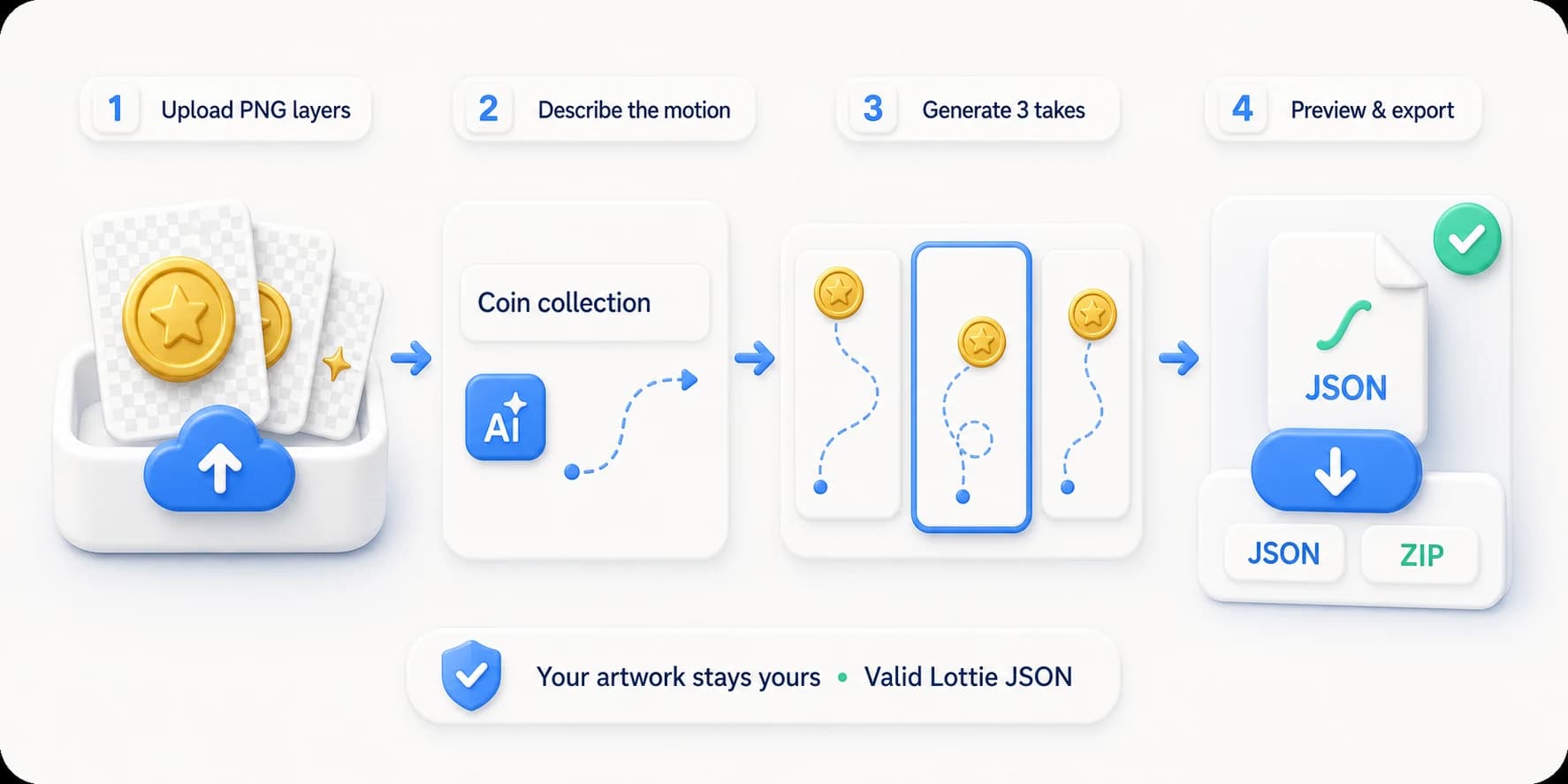
Most text-to-Lottie tools invent the graphic as well as the motion. EasyLottie starts from your PNG layers, so the exported animation keeps your product art, game item, icon, or campaign visual intact.
Add a coin, lid, glow, button, character part, or full-screen artwork as its own layer.
Write “coin collection” or “button press”. AI help can turn it into a precise motion brief.
The AI writes a constrained motion spec. Deterministic code compiles and checks the final Lottie JSON.
No timeline software and no hand-written animation JSON.
Use transparent PNG cut-outs or a full-screen image. Name each moving part.
Keep 1:1 or use Android-friendly 9:20, 9:19.5, or landscape 16:9.
Start with a short idea, use a proven example, or ask AI to write the direction.
Compare three takes, adjust speed and size, then download JSON or a ZIP with separate images.
The generator selects from motion directions learned from production Lottie files, then adapts timing, paths, scale, rotation, and easing to your layers.
Staggered copies follow curved paths toward one target, then shrink and settle.
A quick press, short hold, spring return, and optional ripple at the contact point.
Closed linear rotation and subtle breathing motion without a visible loop seam.
A controlled pop, overshoot, hold, and settle for badges, gifts, and achievements.
The hero layer appears first, followed by staggered particles that spread and fade.
Full-screen artwork uses restrained pan, zoom, fade, and safe entrance motion.
| Decision | EasyLottie with your images | Text-only generation |
|---|---|---|
| Brand fidelity | Your uploaded artwork stays visually unchanged. | The generator may invent a different subject or style. |
| Motion control | Layer names and separate cut-outs define what can move. | The model decides both drawing structure and movement. |
| Output stability | A constrained TimelineSpec is validated before compilation. | Direct Lottie JSON generation can fail silently. |
| Best for | Game rewards, UI feedback, branded icons, campaigns, full-screen effects. | New vector concepts that do not need supplied artwork. |
Transparent PNG files work best for independent moving parts. You can also upload opaque full-screen artwork. Add each part that should move separately and give it a useful layer name.
Yes. Enter a short idea such as “coin collection animation” and choose AI help me write. It expands the idea into a clear path, sequence, timing, and finish that the generator can execute.
No. AI produces a smaller TimelineSpec that only describes layers, transforms, paths, timing, and easing. EasyLottie validates it and deterministically compiles the final Lottie JSON.
The tool supports square 1:1, Android-friendly 9:20 and 9:19.5 portrait canvases, plus 16:9 landscape. Auto mode recommends a ratio from the uploaded artwork.
Yes. Exported JSON works with standard Lottie players on the web, Android, iOS, and React Native. ZIP export keeps image assets separate when your pipeline prefers external files.
No. Upload, generation, preview, adjustment, and export all happen in the browser. After Effects remains useful only if you want unrestricted manual editing beyond this generator’s supported motion features.